
Embracing Automation: Addressing ASEAN’s Manufacturing Challenges
 Lim Boon Choon, President, Hexagon Manufacturing Intelligence for Korea, ASEAN, Pacific
The ASEAN manufacturing sector is at a critical juncture, teetering on the edge of unprecedented growth and formidable challenges. In 2023, foreign direct investment (FDI) inflows soared to a record-breaking $230 billion, a remarkable 24% increase from the annual average of $190 billion between 2020 and 2022, according to UNCTAD’s latest Global Investment Report.
This surge in investment is a testament to ASEAN’s magnetic appeal to global investors, yet it also casts a spotlight on the pressing issues that could impede its progress.
At the heart of these challenges lie quality assurance, manpower shortages, and cost efficiency. As the region grapples with these obstacles, the call for automation has never been louder or more urgent.
Experts contend that automation is not merely an option but a crucial strategy for ASEAN to transcend these barriers and cement its status as a global manufacturing powerhouse.
Manpower Shortages: The Growing Talent Gap
Nowhere is the need for change more apparent than in Vietnam, where realised FDI reached $14.15 billion in the first eight months of 2024, with nearly 80% funnelled into manufacturing (Vietnam Ministry of Planning and Investment). Despite this growth, a severe shortage of skilled workers looms. A ManpowerGroup survey in 2023 ranked manufacturing as one of the hardest-hit sectors in Vietnam’s labour market.
This trend isn’t limited to Vietnam. Across ASEAN’s six largest economies—Indonesia, Thailand, Malaysia, the Philippines, Singapore, and Vietnam—the talent gap is projected to hit 6.6 million skilled workers this year[1].
The scarcity has pushed companies into a “talent tug-of-war,” destabilising production lines as newer factories poach experienced workers from established ones. For instance, in Thailand, the automotive sector has been particularly affected, with companies like Toyota and Honda struggling to maintain production schedules due to skilled labour shortages[2].
Quality and Efficiency: Automation as a Competitive Advantage
As global competition intensifies, ASEAN manufacturers must prioritise consistent quality. Yet reliance on manual processes often leads to variability, product defects, and customer dissatisfaction. Automation solves these issues by ensuring precision, uniformity, and efficiency.
For example, Hexagon’s advanced sensor technologies allow less experienced workers to perform complex tasks accurately, addressing the expertise shortage while maintaining high production standards. In Malaysia, electronics manufacturers like Intel and AMD have successfully integrated automated quality control systems, significantly reducing defect rates and improving product reliability[3]. Automation also reduces waste and downtime, making it a key driver for cost efficiency.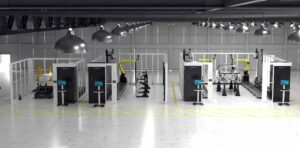
According to Hexagon’s Advanced Manufacturing Report, companies that have adopted automation technologies report up to 30% improvements in efficiency and a 50% reduction in product defects.
These gains underscore the transformative potential of automation in enhancing both quality and efficiency in manufacturing processes.
Overcoming Resistance to Change
Despite its benefits, automation adoption remains sluggish among small and medium-sized enterprises (SMEs), often due to cost concerns. A phased approach—”Start Small, Scale Fast”—can help overcome these barriers.
For instance, a pharmaceutical company in Indonesia struggling with high error rates in packaging could implement automated quality management systems in targeted production areas.
Once the initial investment proves its value, the company can scale automation efforts across other operations. This approach has been successfully demonstrated by companies like Kalbe Farma, which began with small-scale automation projects and gradually expanded them, resulting in significant improvements in efficiency and product quality[4].
Government support is also vital. Singapore’s industrial parks, like Jurong Island, provide a blueprint for fostering technology adoption. By creating integrated ecosystems and offering financial incentives, governments can help manufacturers modernise and remain competitive.
Automation emerges as a practical solution to this pressing challenge.
Innovating for the Future
ASEAN manufacturers can learn from the transformation of South Korean giants like LG and Samsung. These companies transitioned from cost-focused operations to global innovation leaders through sustained investments in quality, innovation, and automation.
This shift allowed them to command premium prices for their superior products.
Similarly, ASEAN manufacturers must move beyond competing on cost alone. Automation and smart factory technologies are no longer aspirational; they are essential for survival in a rapidly evolving industry.
Companies like Vietnam’s Vingroup have already begun this transition, investing heavily in automation for their VinFast automotive manufacturing plants, positioning themselves as serious contenders in the global market.
The ASEAN manufacturing sector has the potential to become a global powerhouse, but this will require bold investments in automation and innovation.
Manufacturers that act now will not only overcome current challenges but also position themselves for long-term success.
By starting small, scaling fast, and leveraging government support, ASEAN companies can transform today’s pain points into opportunities for growth and technological leadership.
[1] McKinsey & Company: https://www.mckinsey.com/featured-insights/asia-pacific/asean-the-next-horizon
[2] Toyota Global Newsroom: https://global.toyota/en/newsroom/
[3] Intel Newsroom: https://newsroom.intel.com/
[4] Kalbe Farma Annual Report: https://www.kalbe.co.id/annual-report


