
Housing construction is becoming manufacturing
Manufacturing is usually associated with making parts and assembling them.
Manufacturing complete houses is a relative new concept in the history of the industrial revolution. We are on the verge of the next step, making the complete structure for a house out of only one material, foam concrete.
Recent developments have made it possible to make foam concrete to high specifications, good thermal and acoustic insulating properties and reasonable strength compared to “normal” concrete. We are talking here about foam concrete that is half the weight and has more than five times the thermal insulation factor.
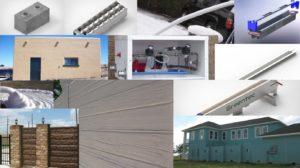
On top of that it is more flexible, so it can withstand earthquakes better. If you are in a war zone it can protect you from flying objects, as it has a high energy absorption rate. All this creates a comfortable, healthy and safe home for a reasonable cost.
So why is everyone not using it? Mainly because the mortar mixes do have a few more ingredients in it, and the ratios of the components are critical, in addition you need a foam making machine to make the foam, and then mix it in with the mortar.
All of this together puts people off using it as it is more complex than making “normal” mortar. In a factory environment it is easier to control the production process, including the curing. As with all concretes the “drying” time and conditions have an influence on the end result, the final strength and flexibility. On-site it can be difficult and costly to maintain the ideal conditions, keeping it wet and at the ideal temperature.
Manufacturing foam concrete products in a special designed facility has many benefits, good control over the delivery and storage of the raw materials, use and maintenance of the equipment, labour input, less skilled labourers can be used, the mixing process can be tightly controlled and automated.
The moulds last longer as they do not need to be transported and handled as much. Finally the pouring and curing can happen under cover, thus not weather dependent, and can be controlled. The end product, block or panels have a very low labour input, compared to conventional building methods.
There are three types of manufacturing systems:
Block making, the simplest form and the product is sold to resellers.
Construction panels: this can be a set of standard products that can be assembled in different ways to make all sorts of different shape and size buildings, or specially designed panels to make up one type of building.
Complete on site manufacturing of the construction of a whole house. The floor is poured and cured first, than all the wall formwork is placed and filled with foam concrete in one go. The roof can also be made of foam concrete panels and placed, or also poured into formwork.
The whole construction is then transported on special house moving trailers. Of course the size of the house is restricted to the capacity of the roads. An intermediate method is modular construction system.
The beauty of these manufacturing processes is that it is nothing new, thus no need for a lot of development capital. Plants to produce these products can be ordered as proven turn-key systems. The only new bit is the mixing formula of the foam concrete.
There are a couple of patented products on the market, and the patient holder licences this formula and help you set up the whole. The return on investment can be surprisingly short, depending of course on how close to full capacity you run your plant, and sell the product.
There are interesting developments happening at present, and one organisation is keeping a close eye on this, the International Foam Concrete Institute has a website where it publishes the latest knowledge, www.FoamConcreteWorld.com


