
To subscribe, advertise or contribute articles to www.asiamanufacturingnewstoday.com contact publisher@xtra.co.nz
  • Home
  • Advertise
  • Subscribe
  • Archives
Asia Manufacturing News
The official site for the Asia Manufacturing News magazine
  • Home
  • AI
  • Analysis
  • Aviation
  • Big Data
  • Business News
  • Calendar
  • Case Studies
  • Change the Conversation
  • Climate Change
  • Covid-19
  • Developments
  • Energy
  • Engineering
  • Events
  • Manufacturing Technology
  • Innovators
  • IoT
  • Manufacturing Technology
  • News
  • Product News
  • Smart Manufacturing
  • The Creative Class
  • The Interview
  • Webinars

News Ticker

Drive down total cost of ownership with data-driven insights
ThaiNamthip completes Asia’s first installation of Sidel’s Hydra Ultrasonic, boosting sustainability and excellence
Eight global climate tech start-ups shortlisted from 1,500 entries for The Liveability Challenge 2026 
MHI completes transfer procedures for domestic onshore wind power business
Nanbu Relay Center completed
UMOE Advanced Composites starts large-scale production in China
Southeast Asia identified as most attractive region for Advanced Manufacturing Investment
MAF801 Expandable Edge AI Computer from IBASE

The future of warehousing in Asia

 E-commerce represents 15 per cent of total retail sales across Asia-Pacific — that is the equivalent to $1.4 trillion US dollars. This figure is expected to more than double by 2021. As a result, warehouses across APAC are rapidly developing and it is easy to see why. Here, John Young, APAC sales director for obsolete parts supplier, EU Automation, discusses the future of warehousing in the region.


The Asia-Pacific economy is the fastest growing region in the world and has the largest share of the world’s business to consumer (B2C) e-commerce market. To meet demand and remain competitive, warehouse managers are investing in efficient and ergonomic technology, such as wearables and Radio Frequency Identification (RFID).


Wearable devices include smart glasses, watches and headsets, whereas RFID often comprise of tags and sensors that store data on a circuit or chip, such as a contactless card.


Stretched funding

Technology has become essential in warehouses and managers are budgeting to invest in and learn more about it. However, by funding new technology, the budget to spend on buying and replacing broken or inefficient machinery and equipment is often cut. As a result, old machinery is often still used beyond its reasonable life, which increases the risk of breakdown.
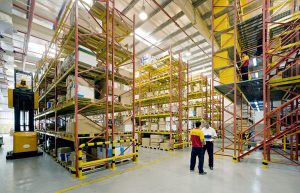
 

If an older machine breaks, it can often prove difficult to source the correct part to fix it, particularly if it has been discontinued by the manufacturer. However, all is not lost. When an old piece of machinery or equipment fails, obsolete industrial parts suppliers like EU Automation can locate the correct part, saving costs for warehouse managers who don’t have the budget for new equipment. This means facility managers can still spend the budget they want on new technology.


Robotic enhancement

Similar to wearables and RFID’s, robots have been introduced to work alongside humans in order to improve efficiency and take pressure off the completion of menial tasks.


As well as improving efficiency and reducing risk of human injuries, using robots means that more time can be spent on training humans for jobs with greater responsibility, which could result in greater pay and higher staff satisfaction.


Robots are widely used in scientific, medical, and manufacturing sectors all over the globe, but more than half of the world’s estimated stock of industrial robots are used in Asia. In fact, the warehouse robotics market in APAC is expected to reach $2.47 billion US dollars by the end of 2022.


Staying ahead of the game

One example of robotics changing the way a warehouse operates is industrial robot manufacturer, Mujin, in Japan. The organisation has developed a smart warehouse prototype, which features robot controllers that can automate the warehouse unmanned.


Robot controllers are combined with existing robot arms that are able to grasp objects. There is one controller for motion planning and one for vision, which generates an automatic motion allowing the robot to pick up an object.


With the retail sales across Asia-Pacific expected to double in the coming years, it’s proving vital that warehouses adjust systems and processes to meet the rapid growth of demand. With some warehouse systems already ahead in preparation of the future, it’s necessary that other facilities meet the same standard in order to remain competitive.


If they do not, the impact could be detrimental. 

Share this:

Related Posts

Singapore 1

Analysis /

NTU Singapore scientists develop cleaner way to recycle mixed plastic packaging

Viet Food and Beverage

Business News /

Vietfood & Beverage – Propack Vietnam 2026 in Ho Chi Minh City

Tamaka

Developments /

Tanaka commences operation of H2 Nexus

‹  iSolutions range to meet Taiwan’s  manufacturing needs› The critical role of IIoT in the future of food processing

22nd July 2026

Recent Posts

  • Vietfood & Beverage – Propack Vietnam 2026 in Ho Chi Minh City
  • Tanaka commences operation of H2 Nexus
  • NTU Singapore scientists develop cleaner way to recycle mixed plastic packaging
  • India engages Monash University to optimise rail maintenance in Dedicated Rail Freight Corridors
  •   DigiTech ASEAN Thailand & AI Connect 2026 forTechnology Leaders, AI Innovators, and Business Decision-Makers 
  • Rigaku Solutions Center Osaka to strengthen global semiconductor metrology service 
  • Drive down total cost of ownership with data-driven insights
  • Murata expands product information management API service 
  • ThaiNamthip completes Asia’s first installation of Sidel’s Hydra Ultrasonic, boosting sustainability and excellence
  • Applied Materials expands Singapore manufacturing to support AI chip demand

Categories

  • AI
  • Analysis
  • Aviation
  • Big Data
  • Business News
  • Calendar
  • Case Studies
  • Change the Conversation
  • Climate Change
  • Covid-19
  • Developments
  • Energy
  • Engineering
  • Events
  • Innovators
  • IoT
  • Manufacturing Technology
  • Manufacturing Technology
  • News
  • Product News
  • Smart Manufacturing
  • The Creative Class
  • The Interview
  • Uncategorized
  • Webinars

Archives

Back to Top

  • Home
  • AI
  • Analysis
  • Aviation
  • Big Data
  • Business News
  • Calendar
  • Case Studies
  • Change the Conversation
  • Climate Change
  • Covid-19
  • Developments
  • Energy
  • Engineering
  • Events
  • Manufacturing Technology
  • Innovators
  • IoT
  • Manufacturing Technology
  • News
  • Product News
  • Smart Manufacturing
  • The Creative Class
  • The Interview
  • Webinars

To subscribe, advertise or contribute articles to asiamanufacturingnewstoday.com contact publisher@xtra.co.nz

(c) Asia Manufacturing News, 2026