
3D Design & Simulation Tools Ushering in a New Dawn for Asian Manufacturing
 Ming Xu – CAE Marketing Manager,Asia Pacific Marketing,Siemens PLM Software.
Asian manufacturers are on the cusp of the next industrial revolution with innovation as the catalyst that is redefining their path to success. With great opportunities come great challenges – the current Asia Pacific manufacturing scenario is seeing multiple impactful factors at play. The pressure to shorten time-to-market, design highly customisable and energy-efficient products is driving companies to rethink their manufacturing strategies.
To add to this, we live in a culture of instant gratification and immediate results. Continuous and consistent improvement is the only way to stay ahead of the competition. To win in this highly complex marketplace, we need to identify trends with the potential of optimizing product development processes in order to maximize our advantage.
Integrated 3D Design and Simulation for Reimagining Processes
A great product is born well before the raw material reaches the machine. High quality products start their journey from high quality designs. Virtual prototyping (the process of creating an optimal physical design in software before building a physical prototype for verification) is experiencing a widespread usage in today’s manufacturing processes. It has assumed a much greater significance in recent years as engineering design has evolved drastically thanks to the availability of cutting edge design tools and software.
Today’s leading manufacturers’ use advanced 3D design (CAD) and simulation (CAE) software in their research and development (R&D) processes to pre-empt, assess and avoid errors. Simulation guides critical trade-off decisions to balance competing product objectives such as reliability, cost and weight requirements. It also plays a major role in product and process innovation.
Both CIMData and Scientific Computing World have noted how pivotal CAD/CAE integration is to product development. Historically, simulation has often been out of step with the design schedule with results too late to be useful. This, in turn, has created frustration, waste and confusion associated with CAE software.
The ability to tightly couple CAD and CAE has a fundamental impact on the way engineers work. Initially, product design used to start with mechanical CAD and then passed to a simulation team for downstream analysis. But now more and more engineers are incorporating CAE during the early stages of product design and development. This shift has made engineering more CAE-centric than CAD-centric which helps speed up the process of creating high quality designs.
Engineers validate and change designs based on simulations conducted during the early part of the concept. This speeds up the design process and improves the overall design guaranteeing the design will work as intended. The CAD/CAE integration enables engineers to collaborate and share information. It supports innovation and there are more ideas readily available to implement and try out. One company using this simulation driven design process is Adams Golf. This has enabled them to achieve faster design iterations within an integrated design and simulation environment.
Engineers evaluate aerodynamic performance drag during the design process helping to achieve shorter product development cycles.
Synchronous Technology Leads to a Change in Culture
The latest advances in synchronous technology make implementing new tweaks to designs faster and simpler – ultimately improving integrated CAD/CAE workflows. It allows designers to edit native or imported CAD geometry in the model without having to understand how the geometry was originally created.
Eliminating the need for the model history, enables a smoother more intuitive interface that leads to faster and more accurate results. This technology also ensures that the CAD and the CAE workflows run simultaneously.
When a user edits CAD geometry, there is no need to manually recreate the analysis model because the mesh and boundary conditions are associated to the base design. The definitions can then be updated automatically to reflect the new, updated design, enabling a faster design than the previous separated CAD/CAE system.
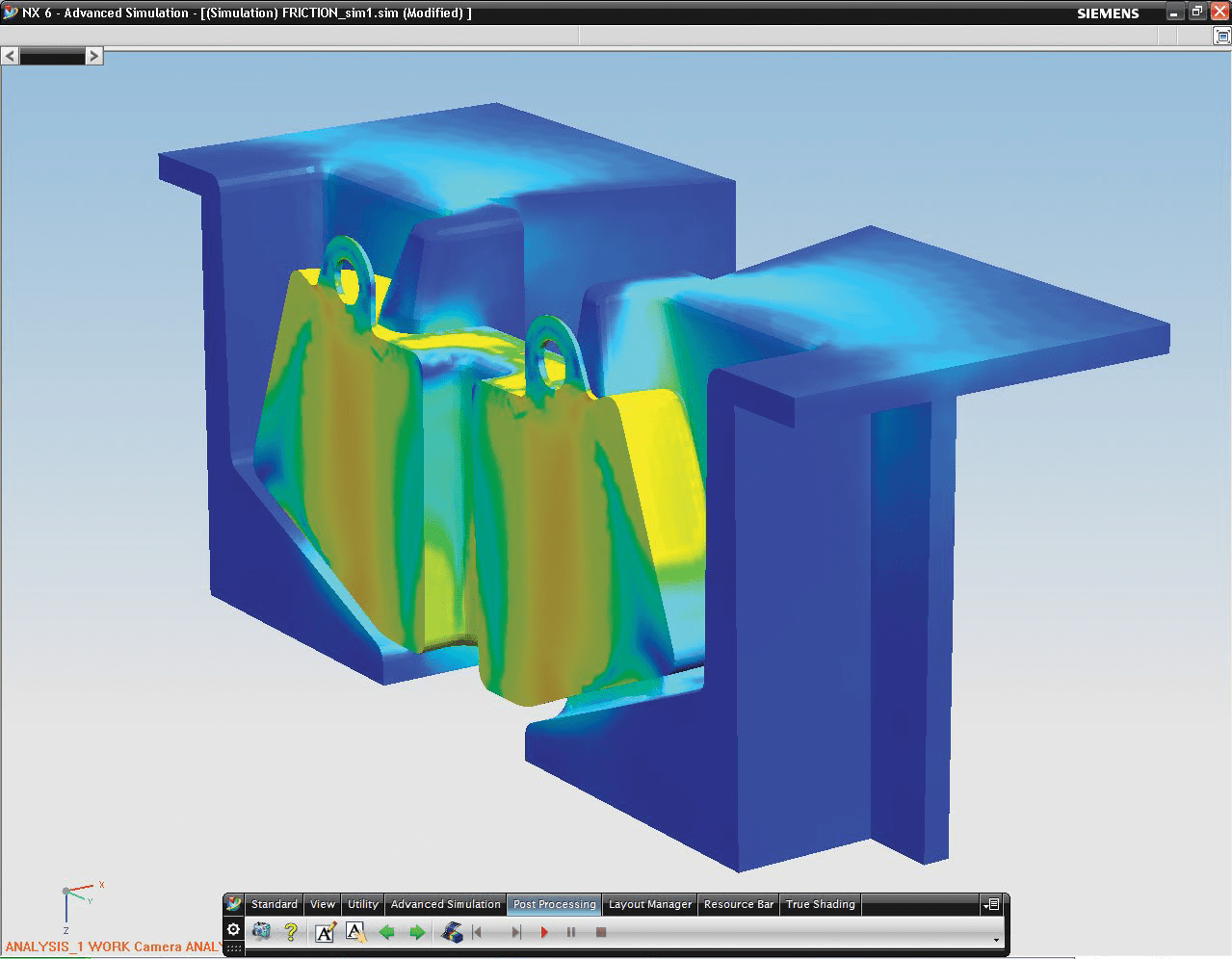 At Damen Shipyard, when analysis results demand a change in design, engineers can apply these changes efficiently using Synchronous Technology – re-meshing is effortless and results in a very short design cycle. All these factors have a significant bearing on time-to-market, resulting in faster, more efficient designs saving millions in revenue for manufacturers.
This simulation driven design process represents a significant cultural change for many companies. In addition to new technologies, these requirements will also call for dramatic changes in processes and attitudes – re-organising the way teams work together and changing old habits.
A Seamless Blend of Design and Simulation
The message is clear – by putting 3D design and simulation together, engineers are better able to understand, predict and improve product performance digitally. More design concepts can be explored, which in turn reduces direct costs associated with expensive physical prototypes enabling faster, more informed decisions.
Siemens PLM Software offer integrated 3D design and simulation software capabilities ushering in a new dawn for Asian manufacturing.


