
To subscribe, advertise or contribute articles to www.asiamanufacturingnewstoday.com contact publisher@xtra.co.nz
  • Home
  • Advertise
  • Subscribe
  • Archives
Asia Manufacturing News
The official site for the Asia Manufacturing News magazine
  • Home
  • AI
  • Analysis
  • Aviation
  • Big Data
  • Business News
  • Calendar
  • Case Studies
  • Change the Conversation
  • Climate Change
  • Covid-19
  • Developments
  • Energy
  • Engineering
  • Events
  • Manufacturing Technology
  • Innovators
  • IoT
  • Manufacturing Technology
  • News
  • Product News
  • Smart Manufacturing
  • The Creative Class
  • The Interview
  • Webinars

News Ticker

esmo Group Marks 25 Years with Simultaneous Expansions in Germany, China, and Taiwan
Drive down total cost of ownership with data-driven insights
ThaiNamthip completes Asia’s first installation of Sidel’s Hydra Ultrasonic, boosting sustainability and excellence
Eight global climate tech start-ups shortlisted from 1,500 entries for The Liveability Challenge 2026 
MHI completes transfer procedures for domestic onshore wind power business
Nanbu Relay Center completed
UMOE Advanced Composites starts large-scale production in China
Southeast Asia identified as most attractive region for Advanced Manufacturing Investment

Robots gesturing for control
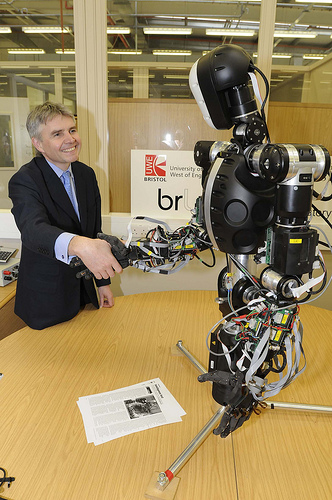
Many works of science fiction have imagined robots that could interact directly with people to provide entertainment, services or even health care. Robotics is now at a stage where some of these ideas can be realized, but it remains difficult to make robots easy to operate.

One option is to train robots to recognize and respond to human gestures. In practice, however, this is difficult because a simple gesture such as waving a hand may appear very different between different people. Designers must develop intelligent computer algorithms that can be ÔtrainedÕ to identify general patterns of motion and relate them correctly to individual commands.

Now, Rui Yan and co-workers at the A*STAR Institute for Infocomm Research in Singapore have adapted a cognitive memory model called a localist attractor network (LAN) to develop a new system that recognize gestures quickly and accurately, and requires very little training.

“Since many social robots will be operated by non-expert users, it is essential for them to be equipped with natural interfaces for interaction with humans,”says Yan. “Gestures are an obvious, natural means of human communication. Our LAN gesture recognition system only requires a small amount of training data, and avoids tedious training processes.”

Yan and co-workers tested their software by integrating it with ShapeTape, a special jacket that uses fibre optics and inertial sensors to monitor the bending and twisting of hands and arms. They programmed the ShapeTape to provide data 80 times per second on the three-dimensional orientation of shoulders, elbows and wrists, and applied velocity thresholds to detect when gestures were starting.

In tests, five different users wore the ShapeTape jacket and used it to control a virtual robot through simple arm motions that represented commands such as forward, backwards, faster or slower. The researchers found that 99.15% of gestures were correctly translated by their system. It is also easy to add new commands, by demonstrating a new control gesture just a few times.

The next step in improving the gesture recognition system is to allow humans to control robots without the need to wear any special devices. Yan and co-workers are tackling this problem by replacing the ShapeTape jacket with motion-sensitive cameras.

“Currently we are building a new gesture recognition system by incorporating our method with a Microsoft Kinect camera,” says Yan. “We will implement the proposed system on an autonomous robot to test its usability in the context of a realistic service task, such as cleaning!”


Share this:

Related Posts

ESMO

Developments /

esmo Group Marks 25 Years with Simultaneous Expansions in Germany, China, and Taiwan

China Atlas Copco

Developments /

Chinese heating and cooling equipment manufacturer to become part of Atlas Copco Group

ISG provider lens

Developments /

Microsoft platforms drive AI modernisation in Asia Pacific

‹ Revolutionary wind power invention receives international recognition› Remanufacturing Centre established

2nd August 2026

Recent Posts

  • esmo Group Marks 25 Years with Simultaneous Expansions in Germany, China, and Taiwan
  • Chinese heating and cooling equipment manufacturer to become part of Atlas Copco Group
  • Microsoft platforms drive AI modernisation in Asia Pacific
  • “Networked AI: Theory and Applications”
  • Vietfood & Beverage – Propack Vietnam 2026 in Ho Chi Minh City
  • Tanaka commences operation of H2 Nexus
  • NTU Singapore scientists develop cleaner way to recycle mixed plastic packaging
  • India engages Monash University to optimise rail maintenance in Dedicated Rail Freight Corridors
  •   DigiTech ASEAN Thailand & AI Connect 2026 forTechnology Leaders, AI Innovators, and Business Decision-Makers 
  • Rigaku Solutions Center Osaka to strengthen global semiconductor metrology service 

Categories

  • AI
  • Analysis
  • Aviation
  • Big Data
  • Business News
  • Calendar
  • Case Studies
  • Change the Conversation
  • Climate Change
  • Covid-19
  • Developments
  • Energy
  • Engineering
  • Events
  • Innovators
  • IoT
  • Manufacturing Technology
  • Manufacturing Technology
  • News
  • Product News
  • Smart Manufacturing
  • The Creative Class
  • The Interview
  • Uncategorized
  • Webinars

Archives

Back to Top

  • Home
  • AI
  • Analysis
  • Aviation
  • Big Data
  • Business News
  • Calendar
  • Case Studies
  • Change the Conversation
  • Climate Change
  • Covid-19
  • Developments
  • Energy
  • Engineering
  • Events
  • Manufacturing Technology
  • Innovators
  • IoT
  • Manufacturing Technology
  • News
  • Product News
  • Smart Manufacturing
  • The Creative Class
  • The Interview
  • Webinars

To subscribe, advertise or contribute articles to asiamanufacturingnewstoday.com contact publisher@xtra.co.nz

(c) Asia Manufacturing News, 2026